Head_primary02
ttk_business_001_03 ttk_business_001_03 ttk_business_001_03 ttk_business_001_03 ttk_business_001_03 ttk_business_001_03 ttk_business_001_03 ttk_business_001_03 email_background04
inner_2702 CMP-botton05 inner_2702
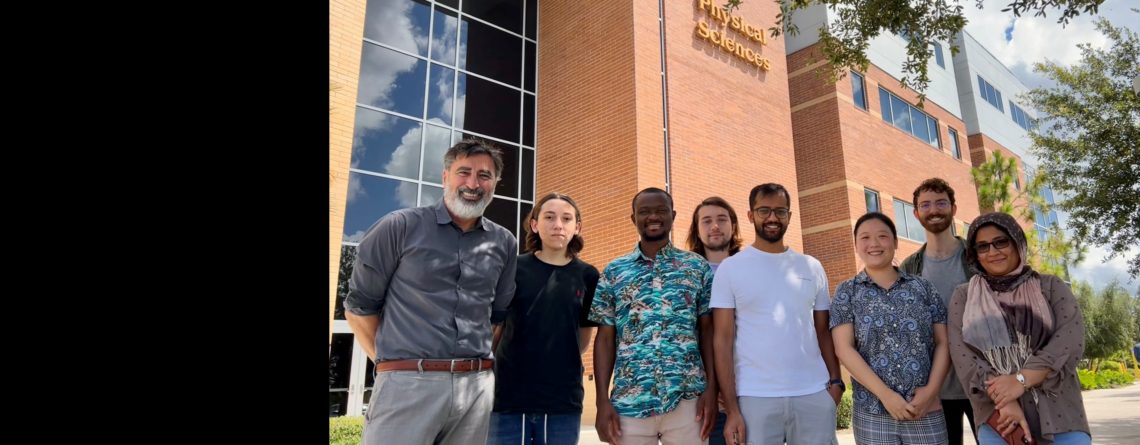
group-photo04
inner_2702
IndexCaptionResearch IndexImageBack IndexImageBack IndexImageBack
IndexImageback2 IndexCaptionSMMs IndexImageback2 IndexCaptionSETs IndexImageback2 IndexCaptionResearchSpintro
Index-banner-outreach04

VISIT OUR ONLINE BLOG “UCF HIGH-SCHOOL SCIENCE”

index-online-blog

Research Overview

Quantum Tunneling of the magnetization

Our research interests are focused on the study of how the microscopic laws of physics –quantum mechanics– manifest themselves at a macroscopic scale. Nanoscale magnetic systems are excellent candidates for these studies due to the fact that one can go from quantum to classical regimes by changing the size of the system under study. One approach to this is by decreasing the size of a magnet to nanometers. When the magnet becomes small enough its quantum properties play an important role. On the other hand, the bottom-up approach consists in taking a quantum (“small”) system and increase its size until arriving at the macroscopic scale. As the system becomes bigger and bigger, more degrees of freedom are available to interact with the environment and destroy its quantum properties.

In general, the size, shape, composition, orientation and other properties of the system, like anisotropy or intrinsic interactions (i.e. dipolar, hyperfine or exchange interactions), are the sources that govern the way in which a system behaves classically or quantum mechanically. An understanding of the interactions that destroy the quantum properties of a macroscopic system (i.e. decoherence) are of fundamental importance in Physics. Nanometer sized magnetic systems offer a great possibility to explore this topic.

We are particularly interested in chemically synthesized magnetic nanostructures and, in particular, materials known as single molecule magnets (SMMs). SMMs consist of a core of strongly exchange-coupled transition metal ions that collectively have a very large magnetic moment per molecule. SMM crystals have a number of advantages over other types of magnetic nanostructures. Most importantly, they are monodisperse—each molecule in the crystal has the same spin, orientation, magnetic anisotropy and atomic structure. They thus enable fundamental studies of properties intrinsic to magnetic nanostructures that have previously been inaccessible. One of the most important results obtained with these compounds is the observation of quantum tunneling between different states of the magnetization of the molecule, leading to a step-wise hysteresis magnetization curve with acceleration of the magnetic relaxation for fields where quantum tunneling is turned on. Such quantum effects are also widely studied in superconducting quantum interference devices (SQUIDs) and quantum dots.

Condensed matter systems like these, with discrete energy levels coupled to the environment in the solid, are important to understanding the border between quantum and classical physics, and the decoherence of quantum systems. From a technological point of view, these systems have several new potential applications. As an example, SMMs have recently been proposed for use in quantum computing and quantum information storage. They also represent the ultimate limit to classical magnetic information storage, with one bit per molecule and possible storage densities many orders of magnitude greater than present day magnetic media. Understanding the quantum properties in these materials and relations with their structural characteristics will enable the creation of new and more adequate molecular compounds useful for quantum information technology and prototypes to study fundamental aspects of nanoscale physics.
6photo

This is a rapidly advancing field with many recent fundamental discoveries. For example, recently a crossover between quantum and thermal regimes of magnetic relaxation has been observed and studied. Berry phase interference in magnetic quantum has also been seen, with minima in the tunnel rates for discrete values of an external transverse magnetic field. This allows turning on and off the quantum tunneling by slightly varying the magnitude of an applied magnetic field. Moreover, a very recent observation establishes that quantum magnetic states of neighboring molecules can be quantum entangled. These findings lead to a very fast grow of the field since 1996, involving close to 30 research groups around the world, both theoretical and experimental, working with different techniques of measurement. This includes dc and ac magnetometry, Electron Paramagnetic Resonance, Neutron scattering or Calorimetric experiments as well as some new high sensitivity techniques that have been developed in the field (i.e. micro-Hall effect or micro-SQUID magnetometry)I


Funding - research support

NSFlogo
AgilentLogo
pegasus
logo-Lockheed-Martin i2logo

Index-news-and-updates02

new02 We have moved to a new lab in the new Physical Science Building at UCF

index_PSB

new02 Amazing Fourth place Prize in the International Science Fair 2009 (Reno)
Austin Coye (highschooler)

Transport studies of ferromagnetism in individual gold nanoparticles
index_Austin_international
Austin does not stop of receiving awards and recognition of her talents. The 4th place in the international fair for a 9th-grader is just unbelievable!

new02 BEST IN FAIR in the State Science and Engineering Fair of Florida 2009
Austin Coye (highschooler)

Transport studies of ferromagnetism in individual gold nanoparticles
Austin_state_fair
This is really a great achievement for a high school student in 9th grade, Austin!
Congratulations from the whole group.

new02 UCF Founder’s Day Outstanding Thesis Award - Science and Engineering
Runner-Up: Juan Carlos Gonzalez-Pons

Honors in the Major Thesis: Geometrical Control of the Magnetization Direction in High Aspect-Ratio PdNi Ferromagnetic Nanoelectrodes

Juan-Carlos

Well deserved JC! We hope that you are having a good time in Seattle, doing what you were born to do (Aeronautics).
Congratulations from the whole group.

Low-temperature laboratory

Low-Temperature Equipment
The lab’s low temperature basic instrumentation is composed by the following equipment:

He3-He4 dilution cryostat: This cryostat allows to work at temperatures as low as 15mK.

He3 cryostat: This flexible cryostat allows quick and flexible measurements in a wide temperature range (from 0.3K to room temperature).


High-Magnetic-Field Equipment

The lab’s high-magnetic-field basic instrumentation is composed by the following equipment:

3D-vector superconducting magnet: This magnet allows the application of high magnetic fields in arbitrary directions, being a precious tool for the study of anisotropic magnetic materials or quantum properties dependent on the direction of the applied magnetic field, such as quantum tunneling of the magnetization in SMMs.


High-Frequency Microwave System

An Agilent Technologies high sensitivity Vector Network Analyzer, working at frequencies from 45MHz to 110GHz, is available for microwave excitation experiments. This system will work at higher frequencies with the use of external multipliers that will soon enhance the high frequency capabilities of our lab.


Magnetic Measurement Techniques

Several measurement techniques are available in our lab. High sensitivity micro-Hall magnetometry and high-frequency Electron Paramagnetic Reson-ance (EPR) spectroscopy are the main tools for characterization of quantum properties of SMMs.

New techniques will result from hybridization of existing measurement techniques. This new techniques will be designed in order to study quantum dynamical properties of the magnet-ization in SMMs. Real-time fast magnetometry and spin-echo experiments will be combined for this purpose.

new02 Topological Interference of Tunneling Trajectories of Interacting Spins

index_NaturePhysics_0

new02 REU at UCF

REU-logo

Differential Equations in Classical and Quantum Physics is an interdisciplinary program betweeen the departments of Physics and Math at the University of Central Florida which has a strong focus on various theoretical, computational, and experimental aspects of differential equations.

YOU CAN DO IT IN OUR GROUP!
Click on the banner above to see the presentation video on the REU site.

Index-news-and-updates-b
foot_page02